ECAIR Year Two
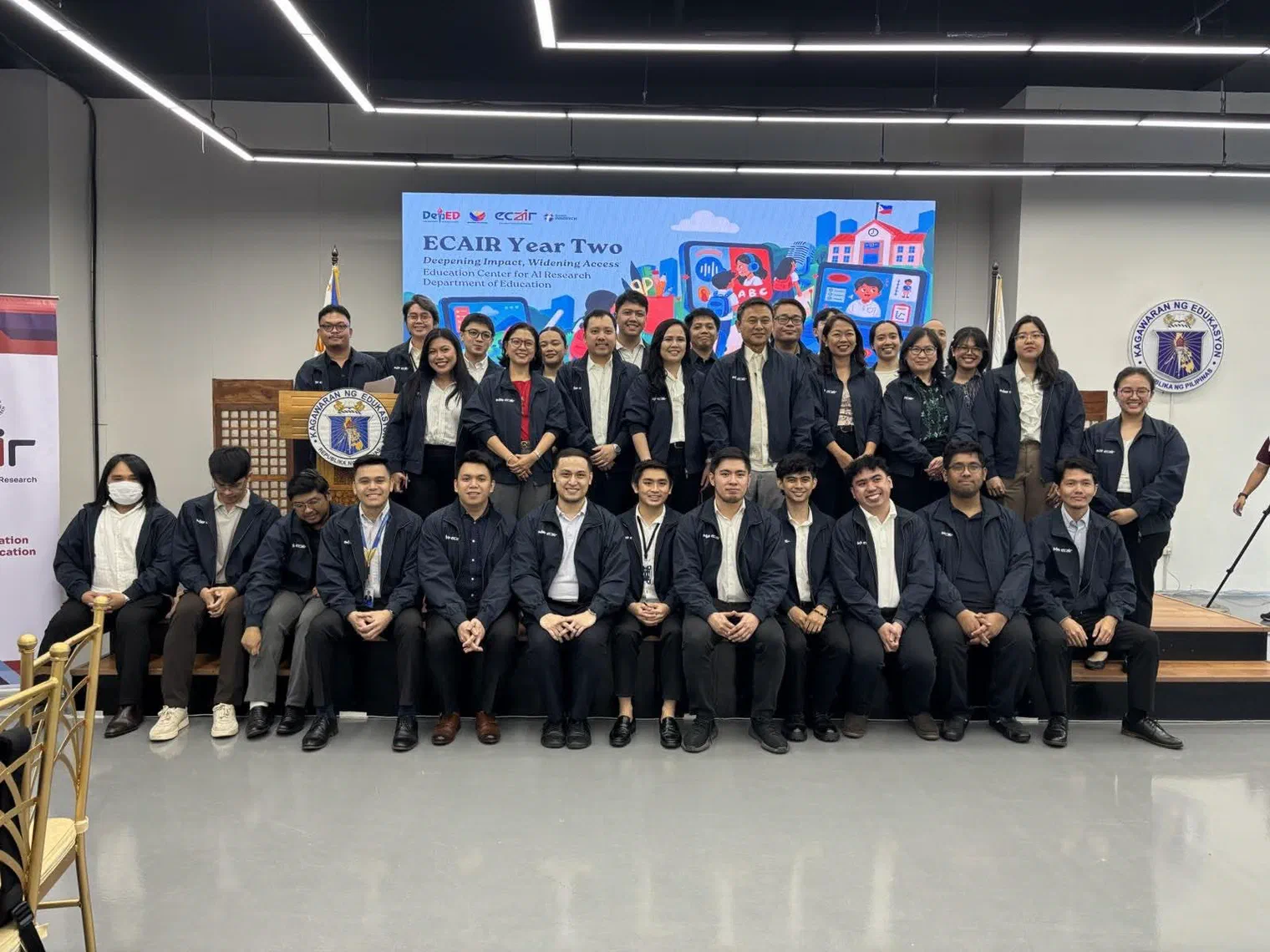
Two years in, AI systems built at ECAIR are in use across the Philippine education sector, and many of the people who use them make decisions for thousands of learners at a time.
On 19 November 2026, we presented the Year Two report of ECAIR, the Education Center for AI Research of the Philippines’ Department of Education (DepEd). DepEd engineers, data scientists and researchers built everything we showed in-house, working side by side with our bureaus, school heads and teachers.
The Philippines has the highest disaster risk in the world, ranking first of 193 countries on the 2026 WorldRiskIndex. Typhoons, floods, earthquakes, volcanic activity and extreme heat disrupt classes every year. LIGTAS+ gives school heads one clear call for their school each day, based on weather and hazard data: Hayo, Hinay, Hinga or Hinto. Since its launch in August, 57,642 people have used it, 83% of them DepEd personnel. Many are school heads, division officers and regional coordinators, so one user often makes the call for a whole school, division or region, and the learners behind those daily decisions number in the millions. Use is voluntary, and about 1,400 people open it every day. Our disaster risk teams now use it for official situation reports.
Five to ten percent of children have a learning or communication disorder. The Philippines, a country of more than 110 million people, has 109 certified developmental pediatricians. Nearly half of their clinics are in Metro Manila, and two entire regions in Mindanao have none, so a child in Samar or Sulu has little chance of ever being screened. We built SABAY because of these numbers. With it, a regular teacher can screen a Grade 2 learner in 14.5 minutes, compared with 45 minutes to two hours for current tools, and a specialist still confirms the result. We collected data across five regions and four language groups so the screening also works for a Waray-speaking child in Leyte.
In school year 2024–2025, more than 300,000 Filipino learners dropped out of Grades 1, 7 and 11 alone. We co-designed TALAAN, our dropout early warning system, with about 120 teachers and school heads from three Metro Manila schools where dropout rates run three to four times the national average. They asked that their own judgment count, so teachers can now flag at-risk learners themselves. Encoding attendance twice was slowing them down, so we automated the school attendance form. TALAAN is now deployed to those teachers and covers about 3,000 learners.
Other work this year included the National Work Immersion Pledging Dashboard, which tracks pledges live: 3,089 companies pledged 61,289 work immersion slots for senior high school learners, 122.6% of the 50,000 target. We also trained 52 personnel from DepEd and TESDA, the national technical-vocational agency, to build and run AI tools themselves.
Two years of this work have shown us that building and running AI systems in government is doable. Done responsibly, and designed with the people who know the system best, the work does real good. This is the education sector’s accomplishment, built by many people and centered on our learners and teachers.
Thank you to Secretary Sonny Angara, Undersecretary Fatima Lipp-Panontongan and Undersecretary Fita Aldaba for pushing for ECAIR in 2025. Maraming salamat to the ECAIR team, and to every teacher and school head who gave us their time and told us what we were getting wrong.